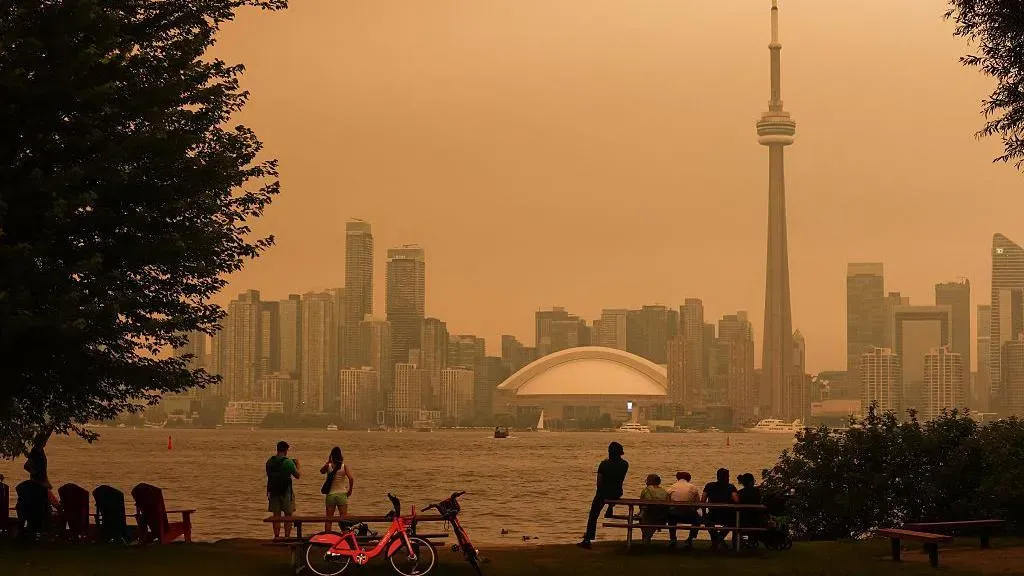
More than 800 wildfires are burning across Canada, with air quality alerts now extending south into multiple US states.
Air quality in large parts of Michigan and Minnesota is classified as "hazardous" by the US Air Quality Index program, with residents advised to stay indoors. Alerts span the Upper Midwest, the Great Lakes region and into the northeast, the US National Weather Service (NOAA) said in an update on Thursday.
There are currently 858 fires actively burning in Canada, including 30 new fires reported on Thursday, according to the Canadian Wildland Fire Information System. The vast majority of the wildfires are burning out of control.
A large cluster of fires in northwestern Ontario is sending thick smoke plumes and poor air quality across Thunder Bay and Toronto, while lower concentrations of smoke higher in the atmosphere are drifting over the Great Lakes and above New York, producing hazy skies and likely redder sunrises and sunsets.
In western New York state, air quality on Thursday is considered "very unhealthy," while the New York City metro area is rated "unhealthy." On Wednesday, New York extended its heat emergency plans and activated air quality emergency protocols, making hundreds of cooling centers and KN95 masks available citywide.
In Ontario, widespread thunderstorms are expected over the next few days, though the rain may not be sufficient to significantly clear the air. Northwesterly winds are forecast to continue pushing smoke into northern US states through the rest of the week and into the weekend, raising concerns that smoke could drift into New Jersey, where the World Cup final is scheduled for Sunday. A shift in wind direction by Monday is expected to steer smoke across Quebec instead, improving air quality further south in the US.
Detroit currently has the worst air quality in the world, according to Swiss air quality tracker IQAir, followed by Minneapolis, Chicago and Toronto.
Republican lawmakers in Michigan have written an open letter to Canadian Prime Minister Mark Carney requesting better management of the country's wildfires, expressing frustration for the third consecutive year. "A year has passed, the season has come around again, and nothing has changed except that our patience has run out," said the letter, signed by four US House representatives from the state.
Pete Hoekstra, the US ambassador to Canada, struck a more diplomatic tone in a statement on Wednesday, commending wildfire-fighting efforts from both countries.
Wildfires are part of the natural life cycle of Canada's vast boreal forest, but they have become more frequent since 2015, according to Laura Chasmer, a professor of geography and the environment at the University of Western Ontario. "This is associated with some of the extreme climate warming that we've been seeing, and the atmospheric drying of the surface," she said.
Fires previously burned more frequently in western Canada, but in recent years that trend has migrated eastward, with large fires now burning in Ontario, Quebec and the Atlantic provinces, Professor Chasmer said, leading to more noticeable smoke in densely populated cities such as Toronto and New York. She added that this has strained firefighting efforts in Canada, where the primary focus is ensuring flames don't spread to nearby towns. Extinguishing the fires completely is "very difficult," she noted, given their scope and intensity.
Responding to criticism from US lawmakers, Carney said on Thursday that both countries share responsibility for fighting climate change. He added that his government is "in close communication" with provinces and local communities and is prepared to help.
Meanwhile, Ontario Premier Doug Ford dismissed criticism of his government's handling of the fires, noting that more than 150 fire crews are on the ground battling the blazes. "We will spend whatever it takes," Ford said.
In addition to the hazardous smoke, wildfires in northern Ontario have forced hundreds of residents from local First Nations communities to evacuate, with videos showing some fleeing the remote area by boat. Homes and buildings in the area have also been extensively damaged by the flames, said Anishinabek Nation Grand Council Chief Linda Debassige in a statement.
A dramatic video on Wednesday showed a freight train in Ontario surrounded by wildfire flames, as workers called for an emergency rescue. Canadian National Rail said in a statement that the workers trapped outside Armstrong were all safely rescued, and that operations in the region have been temporarily suspended.