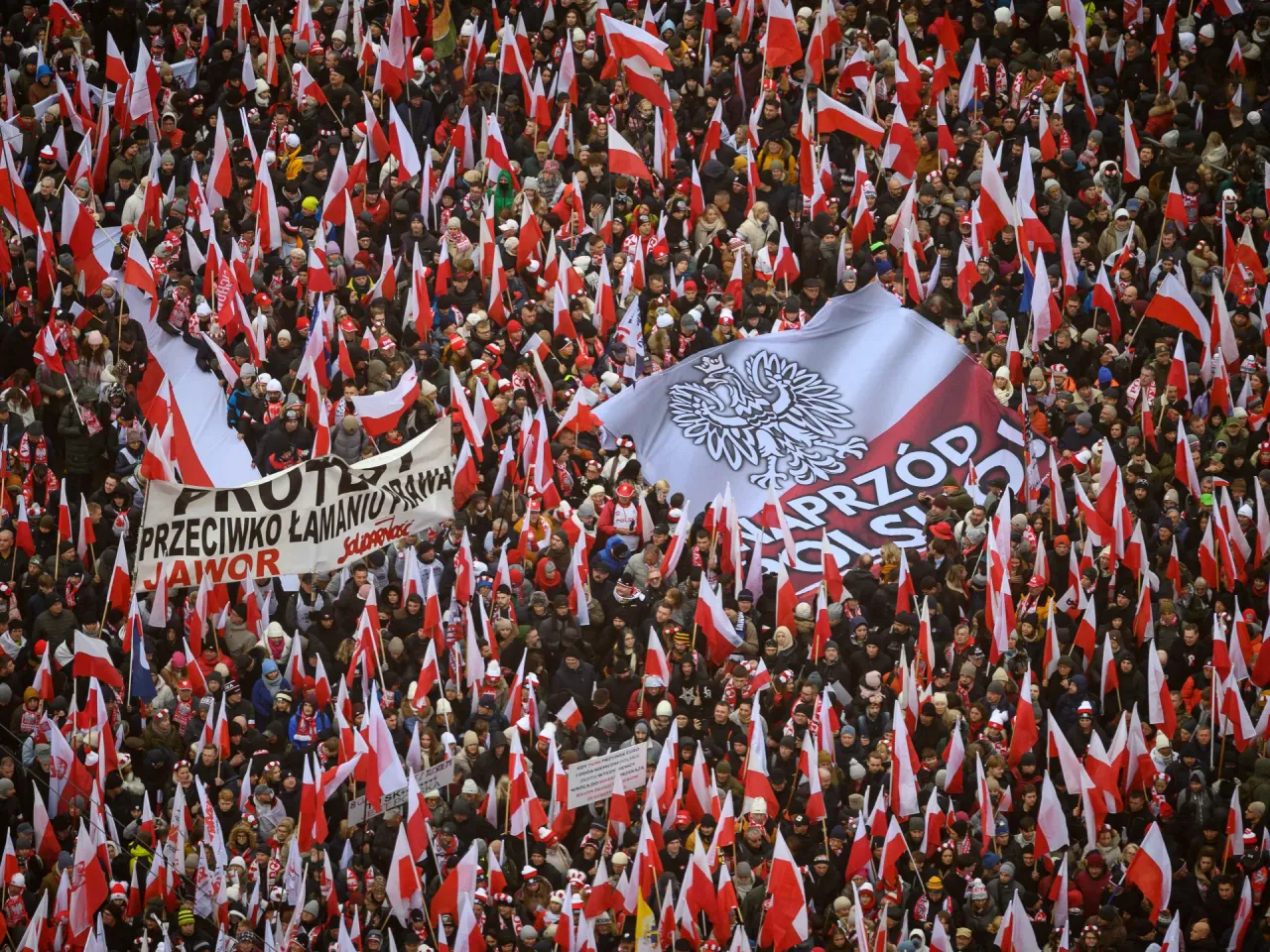
Tens of thousands of nationalist sympathisers gathered in Warsaw on Wednesday for Poland's annual Independence Day march, held just days after a mass shooting in Krakow killed six people and wounded more than a dozen others.
Participants carrying Polish flags assembled in central Warsaw as police were deployed to secure the demonstration.
The march is held each year on November 11 to commemorate the end of over 120 years of partition by Russia, Prussia and Austria, which concluded in 1918. The event has long been a source of tension between right-wing groups and Poland's governing centrists.
Organisers said they expected a record turnout, with foreign nationalist groups also in attendance, including Spain's Revuelta, a youth movement linked to the Vox party, and members of the Hungarian far-right Mi Hazank party.
Poland's conservative-nationalist President Karol Nawrocki attended the march. He has participated in previous years both in his official capacity and as a private citizen. Poland "does not exist today so that the political elites can grant themselves the right to manage citizens ... against the will of the nation," Nawrocki said, in remarks widely seen as directed at the centrist government.
Prior to the march, Prime Minister Donald Tusk appealed for restraint amid heightened political tensions following the Krakow attack on Saturday, November 7. Ministers said the gunman may have been motivated by far-right ideology.
"We may hold different views, we may keep each other in check, and at times we may even be political opponents," Tusk said. "Anyone who truly cares about Poland must understand that this space, defined by independence, freedom and a secure Republic, is a common good."
On Monday, police announced that the 24-year-old gunman had died in hospital after being shot and arrested at the scene on Saturday, when he opened fire from his car in Krakow's main square.
On Tuesday, Justice Minister Waldemar Zurek said the attacker had shown interest in Anders Behring Breivik, the neo-Nazi who killed 77 people in Norway in 2011.
The annual march has faced repeated criticism over anti-Semitic and anti-immigration rhetoric at past events. Supporters describe it as an expression of national pride, held under the motto "A Pole is the host in Poland." Some previous editions have been marred by clashes with police or counter-demonstrators.