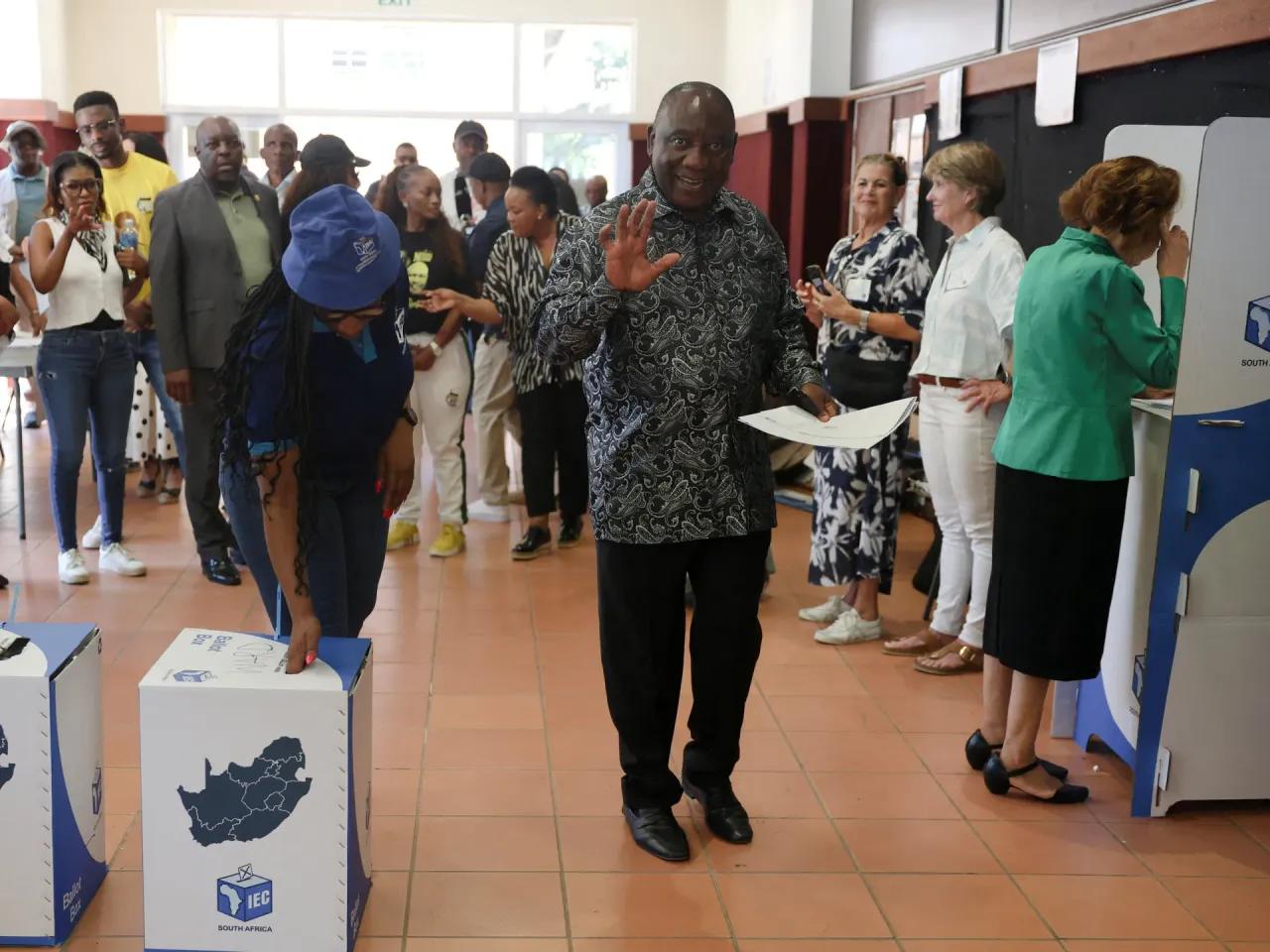
South Africa's ruling African National Congress has suffered its worst electoral result in history, winning just over 30 percent of the vote in last week's municipal elections, according to near-final tallies.
With 98 to 99 percent of votes counted, President Cyril Ramaphosa's ANC secured approximately 31 percent nationally. Its main rival, the Democratic Alliance, came in second with between 24 and 25 percent of the vote, depending on the source. Former President Jacob Zuma's uMkhonto weSizwe party placed third with around 10 percent, while the remainder was split among hundreds of smaller parties.
The result represents a drop of roughly 14 percentage points from the ANC's performance in the 2021 local elections, when it secured 46 percent. In the 2024 national elections, the party had already fallen to just over 40 percent.
Political analyst Daniel Silke described the outcome as the party's lowest point. "This is the most severe result that the ANC would have feared," he said. "It's the ANC's worst result in history," he added, warning that it would undermine the party's ability to exert authority at both local and national level.
The ANC failed to win an outright majority in any of the eight major metropolitan areas, including Johannesburg and Pretoria. South Africa's Electoral Commission confirmed the party lost its majority in six of the eight metropolitan regions.
ANC Secretary-General Fikile Mbalula acknowledged the scale of the defeat. "This has been a very catastrophic outcome for the ANC... as much as we are the largest party, it has been catastrophic for the movement," he said. He added that the party needed to rebuild public trust. "We cannot ask the people to trust us merely because of our history," Mbalula said.
He also signalled that the ANC would not enter coalition negotiations from a position of weakness. "When the people tell us we have fallen short,... the honest answer is not to argue with them but to go home and put our house in order," he said.
President Ramaphosa had not publicly addressed the result as of Saturday evening. During the week, however, he acknowledged in his weekly presidential letter that "municipal failures have contributed to declining public trust and confidence in democratic governance."
Analysts say the result reflects deep voter frustration with corruption, mismanagement, high unemployment, and failures in basic services including water and electricity supply. Unemployment in South Africa currently exceeds 34 percent, more than three decades after the end of apartheid. Smaller parties have also emerged across the political landscape, steadily cutting into the ANC's voter base.
Once led by Nelson Mandela, the ANC was central to ending apartheid and came to power in 1994 when South Africa became a democracy. It governed with an absolute majority for most of its history until the 2024 general election, when it lost an outright parliamentary majority for the first time in the country's democratic era. It subsequently formed a cross-party national unity government with all parties represented in parliament.
South Africa now faces a period of complex coalition negotiations at the municipal level. Parties have 14 days to negotiate before city councils are formally constituted.
In Johannesburg, the DA led the count with approximately 35 percent of the vote, compared with around 20 percent for the ANC. DA veteran Helen Zille, who campaigned on fixing potholes and leaking water pipes, is considered a strong candidate for mayor of Johannesburg, subject to coalition agreements.
The DA is also set to retain control of Cape Town after winning an outright majority there. It performed strongly in Pretoria as well and is expected to pursue coalition arrangements that exclude the ANC.
DA leader Geordin Hill-Lewis said his party had already begun outreach to potential partners. "All of the cut and thrust that comes with the election is now over, and it is time now... to put together governments that can actually fix these towns and cities," he said. "We have already reached out to many parties over the last 24 hours and will continue to do so today," he added.
The DA stated it would seek coalitions with parties that share "a commitment to clean and accountable government, rooting out corruption, service delivery for all, the rule of law, and non-racialism."
Final official results were expected to be announced at 6pm local time (16:00 GMT) on Sunday.
The outcome is also being watched as a potential indicator of voter sentiment ahead of South Africa's next general election, scheduled for 2029.