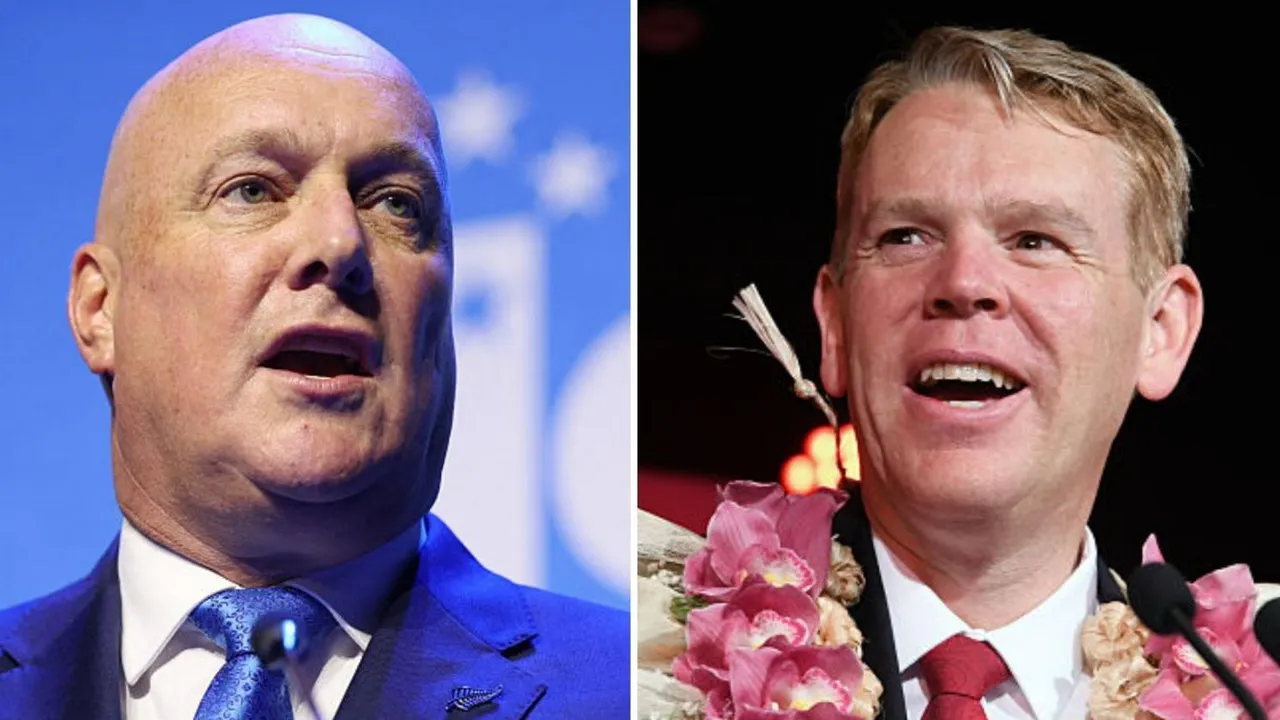
New Zealand's general election on Saturday produced no clear winner, leaving the country facing weeks of coalition negotiations before a new government can be formed.
Preliminary results show Prime Minister Christopher Luxon's centre-right National Party winning 42 seats — the most of any party — but falling 19 short of the simple majority needed to govern alone.
Labour, led by opposition leader Chris Hipkins, won 36 seats. The Greens secured 16, libertarian ACT 13, populist New Zealand First 12, centrist newcomer Opportunity 7, and Te Pati Maori, which represents Maori interests, 5.
More than 99 percent of votes had been counted by Sunday, with National and Labour running neck-and-neck in overall vote share. Their combined share stood at around 60 percent — historically low for the two parties that have long dominated New Zealand politics.
Formal negotiations will not begin until the Electoral Commission releases official results on 27 November. Electoral officials were also due on Sunday to begin counting nearly 400,000 special votes — ballots cast outside a voter's home electorate, including from New Zealanders living abroad. That process is expected to take three weeks.
Those ballots have historically added a seat or two to left-wing parties, which could shift the current razor-thin balance. If no government can be formed, New Zealand could face a fresh election.
Luxon addressed supporters in Auckland as votes were being counted, congratulating Hipkins on a "very hard-fought race" and telling party colleagues: "Whatever the final count, we are incredibly proud of each and everyone of you."
Speaking to reporters on Sunday, Luxon said he would lead a caretaker government until the final results were confirmed. He urged the public to "calm down" and said: "I think everyone's over politics so let's all have a bit of a break for the next three weeks."
He attributed public dissatisfaction to global economic shocks that have hit New Zealand's trade-based economy, noting that incumbent governments worldwide have faced voter anger over the cost of living.
Hipkins declined to concede, saying the "shape of the next government" would remain uncertain "for a while." He told supporters "the people have spoken", adding: "It may take a bit longer to work out what they've said."
Hipkins said the results made clear that "the next parliament is going to require all of us to compromise, to work together and to find common ground."
The election's most striking development was the entry of Opportunity into parliament for the first time. The centrist party, led by 38-year-old business consultant and political newcomer Qiulae Wong, secured seven seats after three previous failed attempts at entering parliament — all before Wong became leader less than a year ago.
Opportunity is unaligned with either major bloc. Wong has said she is open to working with either side, but that her party would negotiate first with whichever party secures the most seats.
Speaking at Opportunity's election night event, Wong told supporters: "We believe that we can change the way we do politics to focus on the future, on the next generation, and on finding common ground."
Professor Andrew Geddis of the University of Otago, an expert in election law, described Opportunity as "a wildcard player" that could "determine which bloc of parties is able to govern."
"It will come down to some very fine vote margins not just between the parties, but in individual electorates. We are going to have to wait for the special votes to be processed and counted over the next three weeks," he said.
The conservative bloc — National combined with ACT and New Zealand First — appeared to hold a slim lead over the left-leaning bloc on Saturday's numbers. However, several senior National lawmakers appeared set to lose their seats on preliminary results, including the ministers of finance and defence, the speaker of parliament, and the attorney general.
The Greens saw their vote share rise by a couple of percentage points. The party has proposed forcing New Zealand's two main supermarket chains to divest stores in order to create publicly owned shops.
The election was shaped by voter concern over the cost of living and unemployment. More than half of the country no longer views New Zealand as a land of opportunity, according to an annual social cohesion survey, and record numbers of New Zealanders have been leaving the country, many relocating to Australia.
New Zealand uses a mixed-member proportional voting system, under which most governments are coalitions. Each voter makes two choices — one for their local constituency representative and one for a political party.