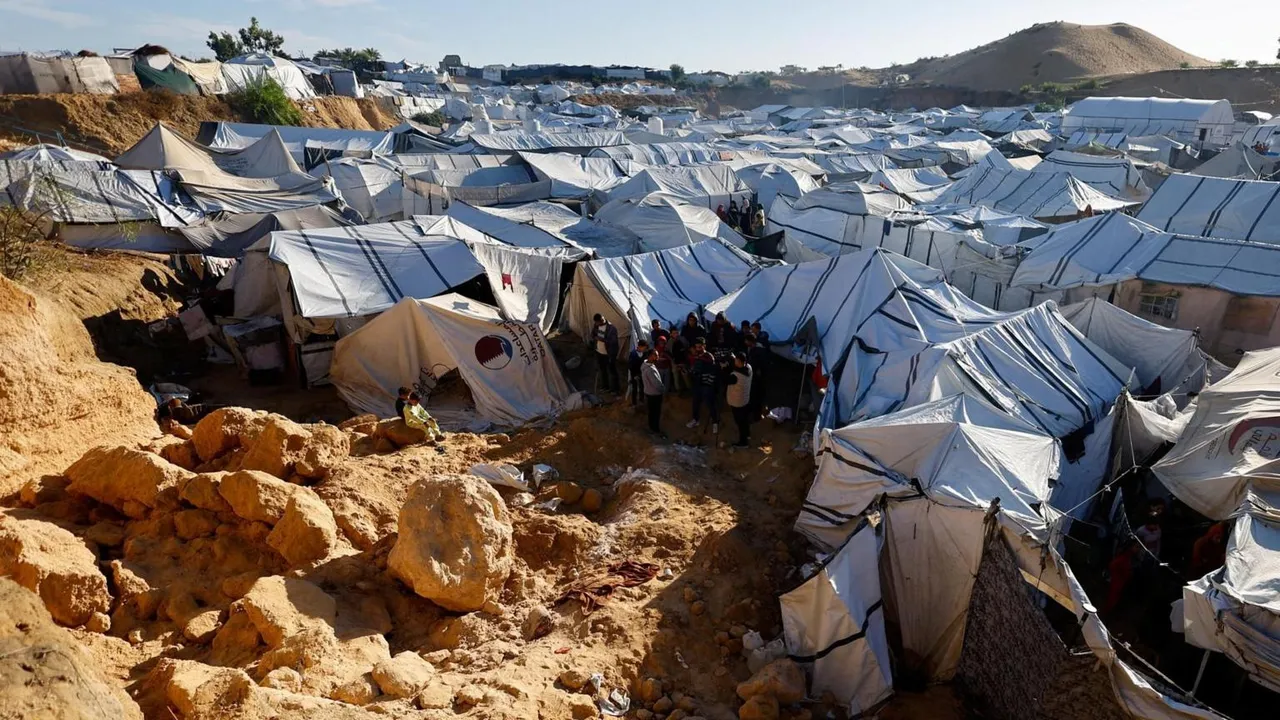
Three children and one woman were killed when a sand embankment collapsed onto tents in central Gaza following heavy rain. Five injured people were also rescued after the incident, which occurred on Sunday night at a camp for displaced families south of Deir al-Balah.
The victims were identified as Tahrir Nabhan, and children Mariam Nabhan, her brother Salah, and Habiba al-Zein. Videos showed men using phone torches to search for survivors beneath boulders, sand and collapsed tents.
The Civil Defence service, which operates under the Hamas-run interior ministry, said the incident should prompt urgent action by international organisations to provide safe shelters for displaced people and move tents away from sandy areas, slopes and locations at risk of collapse.
Torrential rain on Saturday had reportedly flooded tens of thousands of tents across Gaza, leaving many Palestinians without a dry place to sleep. The Civil Defence said water levels reached up to 1.5 metres in some places and that its first responders were able to respond to only 10% of the 2,100 distress calls they received.
"Protecting the lives of displaced people is an urgent humanitarian responsibility. Their tents must not become death traps beneath sand and rainwater," the Civil Defence warned.
A rescuer named Mustafa al-Masri described the effort to reach those buried. "It was extremely difficult. This mound was huge and wide. It collapsed onto the tent, and we didn't know what to do," he said.
"When we got here, we, along with the young men from the camp, pulled them out with our own hands. We pulled out the children and the woman."
He also described the moment the victims' father arrived at the scene. "Their father arrived shouting, 'My children, my children, my children, my children.' We pulled his children out, put them in the ambulance, and took them to the hospital."
Al-Masri said he had been displaced from the northern town of Beit Hanoun but had remained in central Gaza because there was "nowhere for me to return to."
The International Organization for Migration's regional crisis coordinator, Karl Baker, said from Gaza that the territory's 2.1 million population was confined to only 30% of its total area and that many people were "unfortunately living in areas which would not be normal if we were not in this time of conflict."
He said the agency and its partners were working to ensure sufficient tents, tarpaulins and improved drainage in camps ahead of winter. However, he warned that aid currently entering Gaza was not sufficient to meet the needs of the population, describing it as "the very smallest of Band-Aids."
"We need more support, in-kind donations. We need funding in order to help the communities to help themselves," he said. "We need a lot more to happen."
UN agencies have called on Israeli authorities to allow in specialist equipment and materials needed to improve living conditions for displaced families. The Israeli military body tasked with coordinating deliveries said more than 91,000 tents, 12 vacuum trucks for waste removal, and fuel and engine oil for pumping facilities had been delivered since the start of what it called the "Gaza Winterization Plan." It added, however, that Israel would not permit the entry of equipment that could be used for military purposes.
According to the UN, an estimated 80% of all structures in Gaza have been destroyed or damaged during the conflict. More than 1.9 million people have been displaced, many of them multiple times, and 1.2 million are currently living in tents or makeshift shelters.
The UN has warned that the humanitarian situation in Gaza remains dire despite a ceasefire agreed in October 2025, as strikes and other attacks continue to hit populated areas, causing casualties, property damage and further displacement.