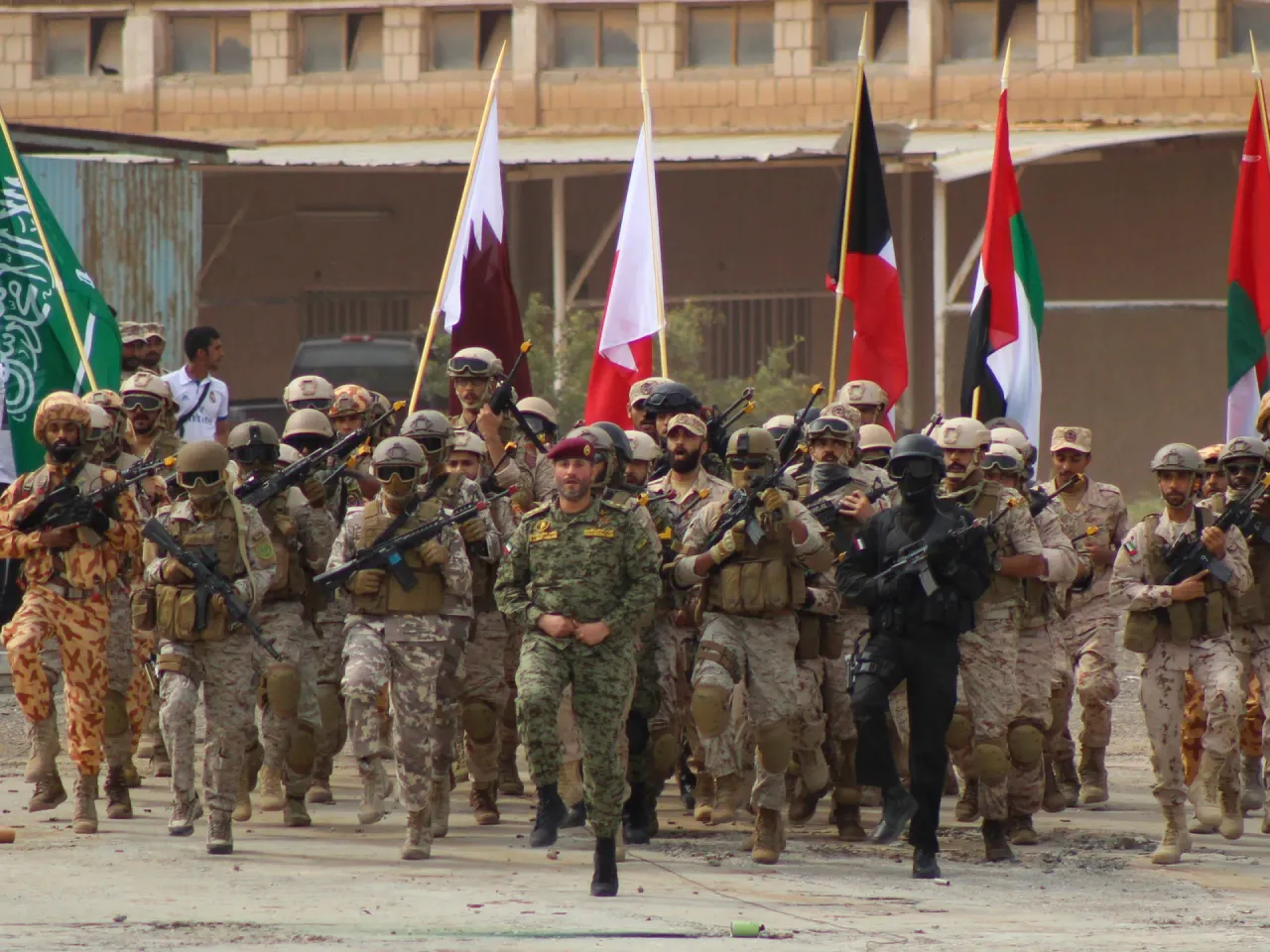
The Gulf Cooperation Council (GCC) has agreed to establish an advanced forward headquarters for its Unified Military Command in Kuwait, along with the allocation of military forces to the new post.
The announcement came on Tuesday following the 23rd meeting of the GCC's Joint Defence Council, attended by defence ministers from the bloc's six member states: Bahrain, Kuwait, Oman, Qatar, Saudi Arabia and the United Arab Emirates.
Details regarding the headquarters' precise location, troop numbers and the types of forces to be assigned have not yet been disclosed.
The Unified Military Command was established in 2013 to coordinate joint operations and strengthen collective defence. Its main headquarters in the Saudi capital, Riyadh, opened in 2021. The bloc's joint Peninsula Shield force dates back several decades.
Experts say the significance of the new post lies in placing a more unified command structure at the northern end of the Gulf. "It puts a unified command at the top of the Gulf, in Kuwait in particular. That means they are establishing a permanent presence there," said Muhanad Seloom, a nonresident fellow at the Middle East Council on Global Affairs.
Kuwait has sought to maintain a moderate position towards Iran, despite having come under attack. The country also faces threats from across its border with Iraq, where Iran-aligned armed groups have launched drones at Gulf states.
"Having a unified command sends a message to Iran and also Iraq, and reassures GCC countries that they are ready for all possible scenarios," Seloom said.
The decision follows a period of heightened regional insecurity. Gulf states, many of which host major US military installations, came under Iranian missile and drone attacks after the United States and Israel launched military operations against Iran on February 28. The conflict disrupted flights and shipping, threatening the oil and gas exports on which much of the region depends.
Although US President Donald Trump stated on Monday that further military action against Iran was unnecessary for now, a US naval blockade remains in place and shipping through the Strait of Hormuz has not returned to normal.
Seloom described the headquarters as part of a longer-term strategic response rather than a reaction to any immediate threat. "I don't think it is a signal of an imminent Iranian strike, but part of a larger GCC strategy to have enough deterrents against Iran."
He added that the conflict had fundamentally altered the regional security order. "Countries in the region, and you can hear this rhetoric from the GCC capitals, want to have their own deterrents."
The GCC statement also explicitly condemned Houthi attacks on Saudi Arabia. Fighting between the Iran-aligned Houthis, also known as Ansar Allah, and Saudi-backed government forces has intensified following years of relative calm after a United Nations-brokered truce in 2022.
"These assaults constitute a flagrant violation of their sanctity and status among Muslims, and a blatant transgression against the security and sovereignty of the Kingdom," GCC Secretary-General Jasem Mohamed Albudaiwi said in the statement.
A Houthi attack on Riyadh's King Khalid International Airport on October 10 killed 14 people and wounded more than 300.
The new headquarters adds to a growing network of overlapping security arrangements across the region. In August, Saudi Arabia, Pakistan and Turkiye signed the Mecca Joint Defence Agreement, stipulating that an armed attack on one signatory would be considered an attack on all three. Saudi Arabia and Pakistan also hold a bilateral mutual defence treaty.